

Our Museum Collection
The Museum Collection of the East Tennessee Historical Society consists of more than 16,000 artifacts and provides a foundation for fulfilling ETHS’s mission to preserve, interpret, and promote the history of East Tennessee’s 35 counties.
East Tennessee’s Museum Collection
The Museum Collection is primarily comprised of objects of material culture that were either made or used in the region or somehow illustrate East Tennessee life and experience in a significant way. A concerted effort is made to represent people of varied backgrounds and from many time periods through the collection.
Particular strengths of the Museum Collection include
- Decorative arts, especially furniture and paintings
- Textiles, especially quilts
- Civil War items, both from Union and Confederate armies, representing the “divided loyalties” so predominate in East Tennessee
Baseball
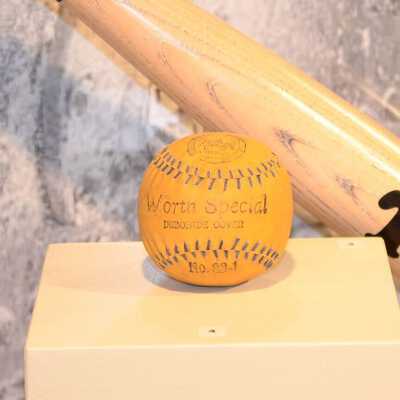
Worth Special Bounder baseball No. 83-1, muddy-gold leather with dark-brown leather stitching, marked "Worth Special / Durohide Cover / No. 83-1," circle on top with "Worth" superimposed with a "N" in the center, "Worth Another Name for Value" around edge of circle, Worth, 2 1/2" diam., 1920s. Fair. Discoloration on gold material, wear on brown engraving, some letters very worn/couple worn completely off. NM 9/10/14 East Tennessee Historical Society purchase
Baseball
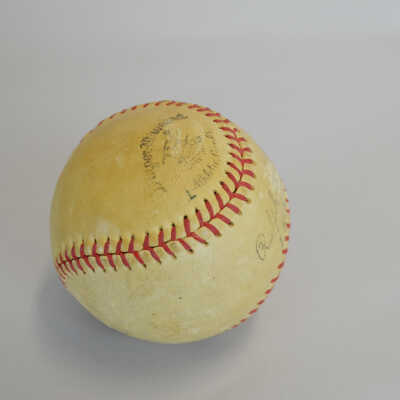
Baseball presented to John W. Green, donors great uncle, in the 1950s honoring him for his work to obtain the land for the Fountain City Parks, stamp "Ralph Kiner / LEAGUE" and "DB 42 / HORSE HIDE COVER" written in black and blue pen "To Judge Green From the Boys & Girls of Fountain City", white horsehide, red stitching, 9 1/4"D.
Bat, Baseball
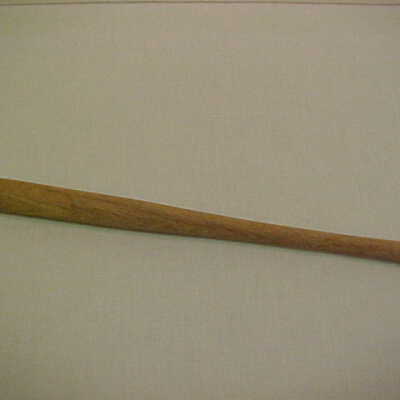
Miniature wood baseball bat, unmarked.
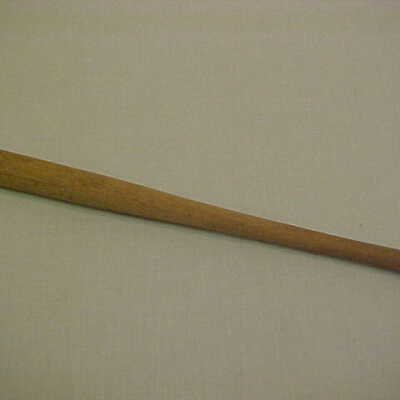
Bat, Baseball
Miniature wood baseball bat, unmarked.
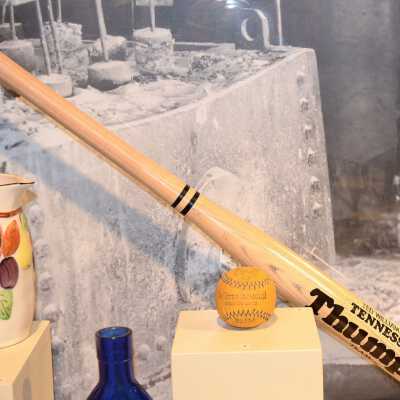
Bat, Baseball
Worth Tennessee Thumper Little League bat, Ted Williams baseball camp model 500 LLT, Tullahoma East Tennessee Historical Society purchase
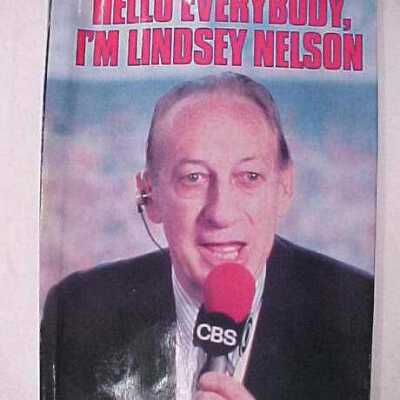
Book
Book jacket with title "HELLO EVERYBODY, I'M LINSEY NELSON" in red block letters at top front, shiny paper, color photo of Linsey Nelson holding CBS microphone, testimonials on inside flaps and back, Beech Tree Books, 9 1/2"l x 22"w (open).
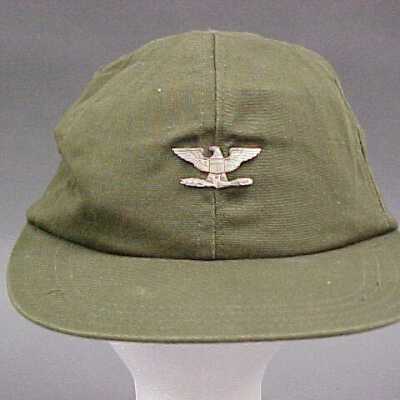
Cap
a) Baseball-type Army fatigue/field cap, olive drab cotton, colonel insignia on front, plastic mesh panel at front interior, size 7 1/4, unknown maker, 4 1/2"h x 8"w x 10"d, 1950.
Cap
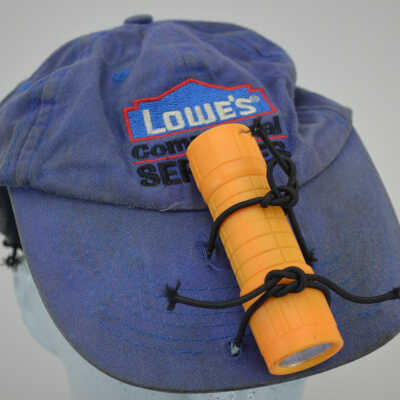
a) Baseball-style cap with embroidered Lowe's patch and "Commercial / SEVICES" centered over brim, royal blue cotton, size 4 (altered with black elastic), cord attached to back and four holes cut in bill with black elastic cord threaded through hold small washlight, white tape holds hat together at back, BD (Woodinville, WA/China), 5 1/8"h x 10"w x 11", 1990-2015. b) Orange flashlight with LED lights laced to brim. powered by three AAA batteries (removed), black button at end turns light on, 3 7/8"h x 1 1/8"diam.
Card, Calling
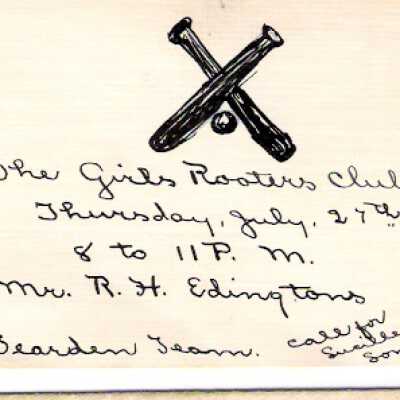
a) Calling card for the Bearden baseball team's "Girls Rooters Club," hand-drawn crossed bats and ball, date of Thursday, July 27 could be 1905, 1911, or 1916. b) Envelope addressed to Mr. Albert Lones, Bearden, Tenn. NOTE: It is believed that this card dates to 1905, 1911, or 1916, as those are the years during which July 27th fell on a Thursday (as noted on this calling card). Albert Sidney Lonas would have been 18, 24, and 29 respectively. Thursday the 27th didn't occur again until 1922, at which time Lonas would have been 35, which may be a less likely age.
Glove, Fielder's
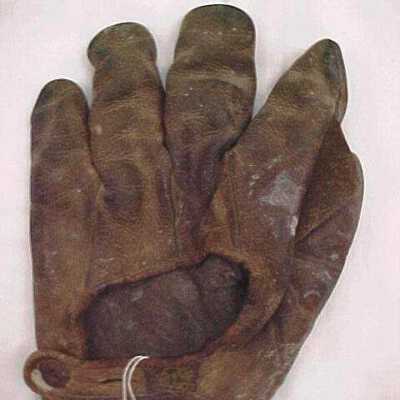
Baseball glove used by Albert Sidney Lonas, leather, four fingers and thumb with rough leather web between thumb and finger, plastic button-held strap across back of hand bears black fabric label marked "A. J. REACH/ TRADE/ REACH/ MARK/ PHILA./ REG.U.S. PAT." in yellow, early 1900s.
Label
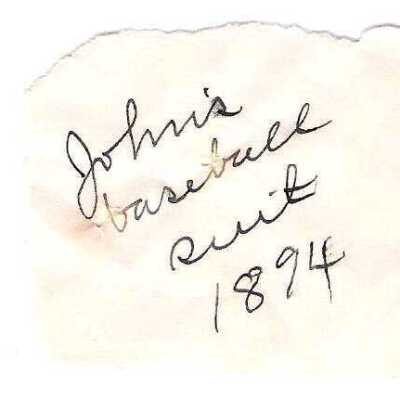
Label marked, "John's baseball suit / 1894." Appears to have been formerly fastened to uniform as evident of pin holes.
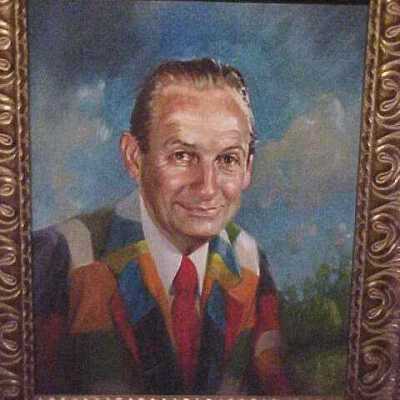
Painting
.1) Lindsey Nelson: portrait painting by A. Lee Lively .2) biographical plaque Insurance value $750 + $75 = $825
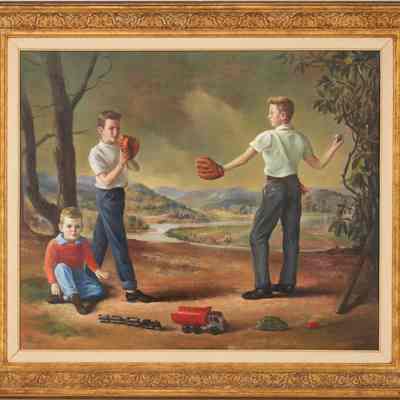
Painting
Large Edward Hurst (American/Tennessee, 1912-1972) oil on canvas group portrait painting depicting three young members of the Howard family of Knoxville, TN. The two older boys play catch with a baseball while the youngest is seated on the ground with a toy train and cars. The spot where the boys are playing overlooks the Tennessee River and Lyon's Bend in the distance, beneath a cloudy sky. Signed and dated "Edward Hurst '59" lower right corner. Housed and matted in a molded giltwood frame. Sight: 29 5/8" H x 35 2/8" W. Framed: 39 1/8" H x 45 1/8" W. Biography: Edward Hurst was born in Knoxville, Tennessee, in 1912. He studied under Catherine Wiley and at the Art Students League in New York, where he also studied with George Luks. He also studied in Europe at the Academies in Florence, Italy, and Munich, Germany. Primarily known for his still-life paintings and commissioned society portraits, Hurst spent much of his life in New York and London, while also maintaining a studio in Knoxville. During World War II, he taught camouflage to soldiers in the United States Army. In 1959, he was diagnosed with an allergy to oil paint, prompting him to work instead with watercolor, conte, and colored pencil on paper. Hurst was a member of the American Artists Professional Club, the Southern States Art League, and the National Arts Club. An example of Hurst's work is illustrated in "The Art & Furniture of East Tennessee" by Namuni Hale Young, p. 105, figure 58. Sources: "Art & Furniture of East Tennessee" by Namuni Hale Young; "Camoupedia: A Compendium of Research on Art, Architecture and Camouflage", by Roy H. Behrens; the Knoxville Museum of Art.
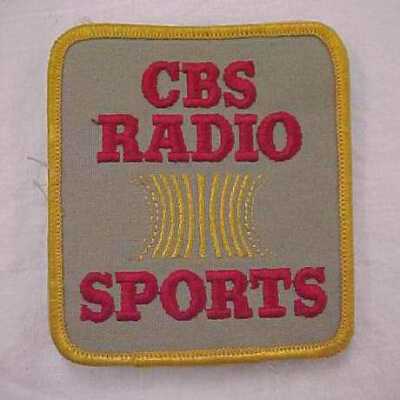
Patch
Rectangular gray cloth patch with rounded corners, gray cloth backing with three metal clutch pins, yellow piping around perimeter, red captial lettering: "CBS/ RADIO/ SPORTS" with set of yellow parallel diverging lines between "RADIO" and "SPORTS," 4"l x 3 1/2"w x 1/2"d
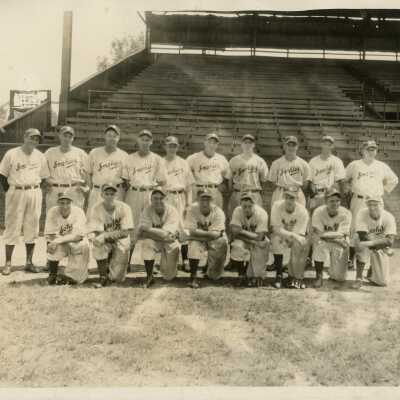
Print, Photographic
Photograph of Knoxville Smokies Baseball Club, 8"h x 9.75"w, mid-20th century, 1946-1979.
Print, Photographic
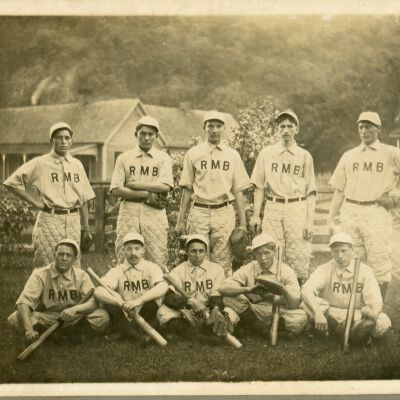
Sepia photograph of baseball team from Orme, Tenn., shows 10 young men (5 sitting on the ground with bats and 5 standing behind)/wood fence and houses in the background, uniforms marked with "RMB" (for Red Men Band), reverse stamped "Made By/ BOTTOMLEE THE PHOTOGRPAHER. GUILD, TENNESSEE," 1907-1912*. * NOTE: Horton left the Army in 1907. The Yamassa Tribe No. 67 of the Red Men Society was instituted in Orme in 1906. "The Story of Marion County Its People and Places," compiled by the Marion County Historical Society and published in 1990, shows a photo of the Orme Band taken in the same spot and dates it to c. 1912.
Print, Photographic
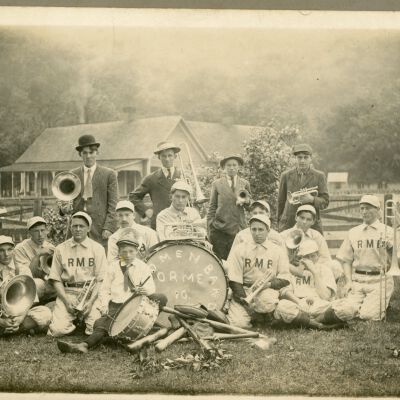
Sepia photograph of 10-member baseball team sitting/kneeling on ground/4 males stand behind in suits/young boy sits at front with small drum, others hold horns (trumpets, bugles, etc.), large drum marked "[?]D MEN BAND/ ORME/ 10" sits at center, wood fence and houses in background, "RMB" on uniforms (for Red Men Band), 1907-1912. "10" on drum may stand for the number of men in the band. * NOTE: Horton left the Army in 1907. The Yamassa Tribe No. 67 of the Red Men Society was instituted in Orme in 1906. "The Story of Marion County Its People and Places," compiled by the Marion County Historical Society and published in 1990, shows a photo of the Orme Band taken in the same spot and dates it to c. 1912.
Print, Photographic
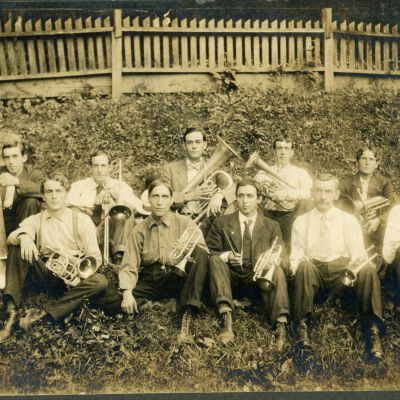
Sepia photograph of 10 members of the Red Men's Band of Orme in dress clothes/boots holding horns (trumpets, tuba, trombone, etc.), all sit on the ground/wood fence in background, reverse marked "from Wm. M[?] Jr./ to C C Horton," perhaps Orme, Tenn., 1907-1912. All but perhaps one man appear different from previous two Red Men Society photos; unknown if these gentlemen are also part of that fraternal organization. * NOTE: Horton left the Army in 1907 and is believed to have been in the Orme, Tenn., area sometime after that. "The Story of Marion County Its People and Places," compiled by the Marion County Historical Society and published in 1990, shows a photo of the Orme Band taken c. 1912.

Sign
Bill Meyer stadium sign
Uniform
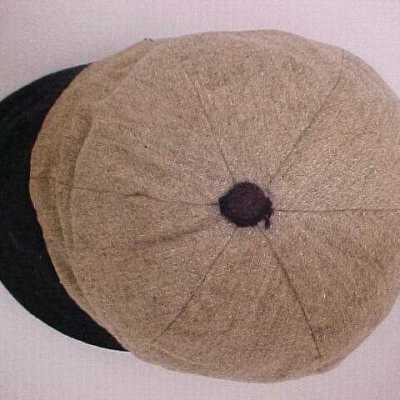
Baseball uniform--shirt, pants, and cap--worn by Albert Sidney Lonas, wool, early 1900s. .1) shirt--course gray wool tweed with navy-blue wool on reverse of collar and around sleeve ends, pull-over style with three white mother-of-pearl buttons at top front closure, collar, short sleeves, "BEARDEN" lettered on front in blue felt with “N” sewn on backward, machine sewn, hand-sewn unmarked fabric tag at interior back neck, back tail hangs slightly longer than front, v-notches at sides, 15 1/4"w between shoulder seams, 37 1/2" from sleeve tip to sleeve tip, 31 1/2" long from collar top to edge of back tail. White dry cleaning/laundry tag removed from interior lining. .2) pants--course gray wool tweed with narrow navy-blue strip down either side, short knicker style, fabric gathered at bottom of legs, front button closure with all four silver-metallic buttons, six self-fabric belt loops, back pocket at wearer's proper right side, machine sewn, brown stripe on off-white background fabric sewn along interior waistline with unmarked fabric tag attached, 28 1/2"l x 17 1/4" at waist and 30"w at upper hip. .3) cap--gray-tweed wool fabric seamed in six segments with navy-blue wool-covered metal button at top and blue visor (three concentric rows of thread detailing conform to curve of brim), lower visor is slightly different shade of blue, interior gray cotton liner, appears small, unreadable writing in black ink on visor-side of liner, 6"w edge to edge x 8"d. White dry cleaning/laundry tag removed from interior lining.

 →
Donate to the Collections
Historical objects are powerful connectors to the past. As educational tools from which we can learn about individuals and eras, these artifacts are a valuable historical resources.
 →
Artifact Acquisition Fund
Artifacts transcend time to communicate the stories of the past. These “messengers from the past” place us in the presence of history. Help fund our next acquisition.
 →
Artifact Conservation Fund
In some cases, objects are in need of conservation work. Conservation work can be a very expensive cost and in many cases one that the museum cannot afford. Fund our next conservation project.