

Our Museum Collection
The Museum Collection of the East Tennessee Historical Society consists of more than 16,000 artifacts and provides a foundation for fulfilling ETHS’s mission to preserve, interpret, and promote the history of East Tennessee’s 35 counties.
East Tennessee’s Museum Collection
The Museum Collection is primarily comprised of objects of material culture that were either made or used in the region or somehow illustrate East Tennessee life and experience in a significant way. A concerted effort is made to represent people of varied backgrounds and from many time periods through the collection.
Particular strengths of the Museum Collection include
- Decorative arts, especially furniture and paintings
- Textiles, especially quilts
- Civil War items, both from Union and Confederate armies, representing the “divided loyalties” so predominate in East Tennessee
Linda Claussen and the Thursday Bee Quilt Collection
Textile highlights from the "History Under the Covers" presentation.

Coverlet
Overshot coverlet woven by Caroline Walker Shelton according to oral tradition, Cat Tracks and Snail Trail variation,* dark brown (possibly from walnut dye) on cream, cream squares in a square with dark brown borders and dark brown diagonals and wavy lines as background, two 32" pieces hand sewn at center, hand hemmed top and bottom edges, 84"l x 65"w, c. 1918 (per photograph of John Walker). * pattern name per book "Of Coverlets" by Wilson and Kennedy
Coverlet
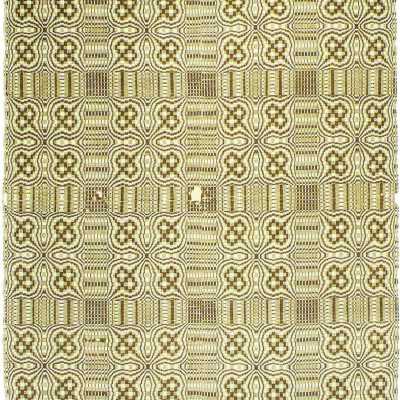
Overshot coverlet attributed to Rachel Blackmore McLin or Rachel and Lucinda McLin Carson or Sophia Caroline McLin, "Flourishing Wave" pattern in light-olive green wool and natural warp, cotton warp/wool/and cotton weft, 84"h x 60"w,17.25"h x 15.5" pattern repeat, epi 36 ppi 80, mid-19th century.
Coverlet
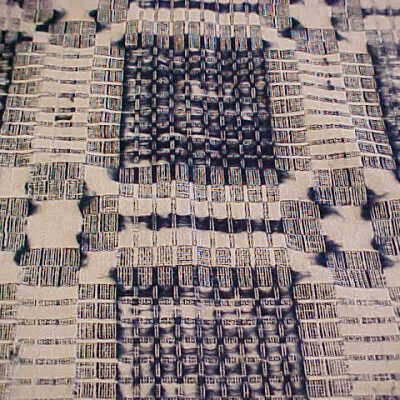
Overshot coverlet, blue and white, linsey-woolsey*, 1835-1883. * linen warp and a wool weft
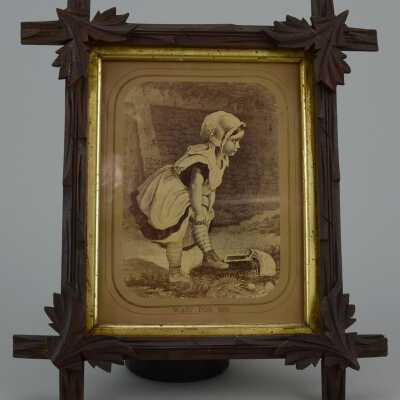
a) Print, sepia paper mounted on cardboard with title "Wait for Me" in gold at bottom front, shows right profile of young girl in bonnet/pinafore/high-button shoes in outdoor setting stopping to tie up her sack and looking forward, slate and cloth bag on ground by her left foot, stone wall in background, artist unknown, c. 1900. b) Frame rustic dark wood carved to resemble tree bark, carved double leaf at each corner, gold painted liner, back set in wtih small nails, eye bolt with wire woven through and twisted at middle, wood backing, Victorian/c. 1900.
Quilt
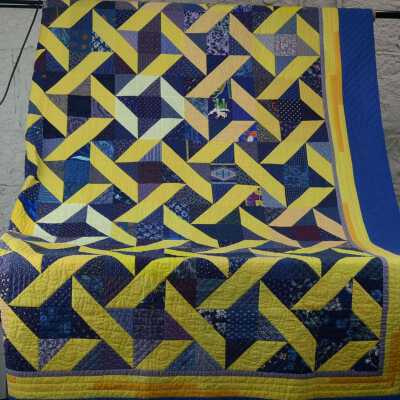
a) Political quilt named "Yellow Ribbons," queen size/41 blocks pieced in blues/purples/yellows, bright yellows set on diagonals with darker contrasting squares and triangles, four-strip border in purple and yellows, broader blue border with yellow ribbon outline, block drawing made by Linda Claussen*, blocks made by members of the Smoky Mountain Quilters of Tennessee (SMQ), set by SMQ member Joan McGinnis*, hand quilted mostly by Doris Vannoy (donor's mother) but also members of SMQ, 113"h x 77"w, 1990-1991/completed 1991. Hanging sleeve. Signed on top right front border by former hostage Terry Anderson, fall 1993. Yellow has chosen to support those in the military going to Saudi Arabia during the Gulf Wars, but scrap blue and purple fabrics, selected by each quilt maker, were intended to honor those who served in Vietnam years earlier. * SMQ members who made blocks: Lessie Werner, Happy Eubank, Barbara Moran (2), Linda Claussen (4), Judy Coram, Joan McGinnis, Jean Lester (2), Eva Earle Kent, Judy Elwood, Dot Gaitanis, Becky Harris (2), Sue Watson, Julie Wolf, Merikay Waldvogel, Pat Blankenship (2), Suzanne Haase, Sue Whaley, Betty Byrd (2), Mary Farmer, Shirley Clapp (2), Lisa Phillips, Jaene Wylie, Jo Bennett, Karen Sharp, Carol Whitehouse, Ruth Shirley (2), and Rose Ann Thurston. b) Blue-bound fabric block with signatures in grid showing who made each block, dated. [At time of donation pinned to back right corner.]
Quilt
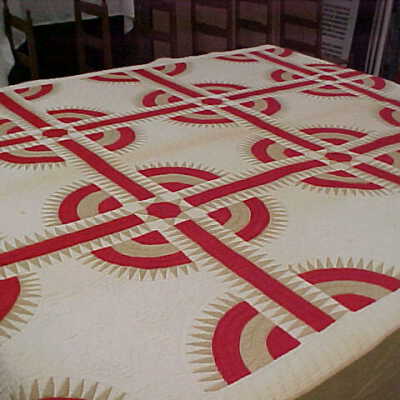
Quilt in the Crown of Thorns pattern (also known in Tennessee as Rising Sun); all cotton fabrics in red and beige (thought to be originally green) on an off-white background; pieced; cotton batting; quilted and bound by hand, quilting is grape vine with leaves and fruit (in the off-white background) and by the piece (around designs); 1870s-1880s based on pattern, color and fading of green to beige. c.1850-1870 per donor; 1870s-1880s per quilt historian Merikay Waldvogel of Knoxville, 8/9/2006.
Quilt
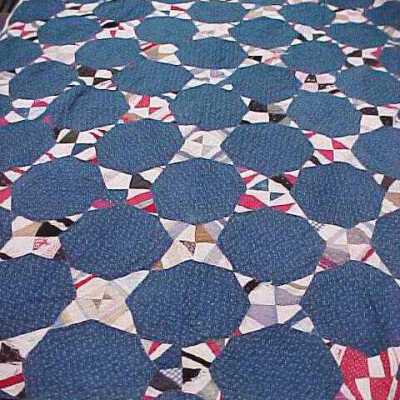
Quilt in a string star pattern made by Elizabeth Shields, "1915" embroidered in white on the diagonal in one corner, palette of blue prints, maroon, gray, red, stripes, and gingham check; blue-and-white print was popular for women's shirt-waist dress, long sleeves and long skirts, one of gray fabrics appears to be linen (hand woven?) perhaps tow from making sacks; black fabric is mourning cloth pieced by hand, quilted by hand with coarse boss ball thread (purchased, sold commercially, not expensive); muslin backing with machine stitching at the center; binding by hand, back-to-front.; cotton batting; appears to have been used and washed, 72"l x 58"w. * fabrics confirm a date of 1910s, per quilt historian Merikay Waldvogel
Quilt
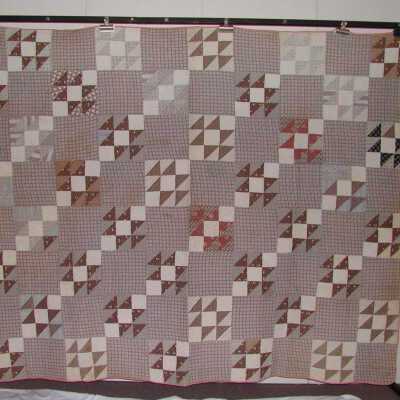
Quilt, pattern is Double X (per Brackman #1692a), pieced by the block, pieced and plain squares (alternating set), 80 blocks, handsewn, cotton prints in brown, off white, blue and rust, quilted with white cotton thread in parallel lines and cross hatching (6-7 stitches/inch), applied binding pieced with two fabrics, no borders, rounded corners, muslin backing, cotton thread, cotton batting, 82"h x 65 1/2"w, 1860-1880. Per Knoxville quilt historian Merikay Waldvogel: brown print fabrics c. 1870
Quilt
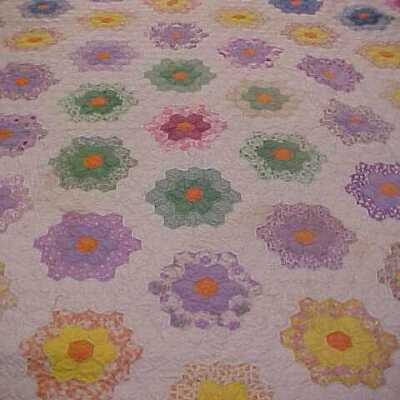
Quilt made by Florence Day McKamey, "Grandmother's Flower Garden," or simply "Flower Garden," pattern. Cotton prints, probably dress (and not sack) fabric. Predominately white background. Flowers begin in center and then radiate in circular pattern. Central flower is pink followed by green ring of flowers, purple ring of flowers, yellow ring of flowers, blue ring of flowers, pink ring of flowers, and a green ring of flowers. Six-sided patches have six-sided quilting inside. Edge of quilt is deeply scalloped, all bound. Backing is white. Hand pieced, hand quilted. 1930s-1940s. Comments from Merikay Waldvogel, 3/16/2004-- The deeply scalloped, bound edge is hard to do.
Quilt
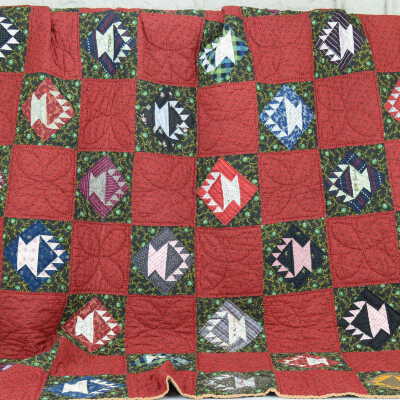
Signature quilt from Greene or Hancock County, cotton fabric, pieced basket-pattern squares made by various sewers, some signed/some initialed in pen, all set in black-print squares with red print blocks quilted with flower design, middle square signed "J. G. Johnson" with "Grady" in lower right corner, date "1899" written on some baskets, two baskets dated "Feb 22 1899," cream/brown/blue small plaid backing, 75 1/2"h x 66 1/2"w, 1899.
Quilt
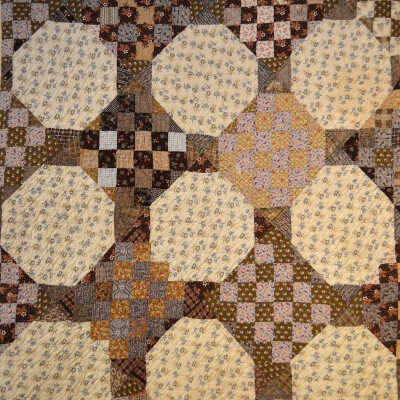
Quilt in "Pavement"* pattern attributed to Martha E. Carson, Lucinda McLin Carson or Sophia Caroline McLin, pieced areas primarily earth tones with some blues/lavenders, large field areas in cream background with small blue flowers with now-brown stem and leaves, natural muslin backing, binding in cream with blue flowers, mostly diamond quilting, 90"h x 70"w, c. 1880-1890*. (*pattern name and date per quilt historian Merikay Waldvogel) Quality of piecing lacking, points not aligned,. Note: some fabrics in this quilt are also in 2017.14.1--light-brown pinstripe, dark-brown with white flowers. * "Checkerboard" pattern, c. 1865 per Freeman's auction catalog
Quilt
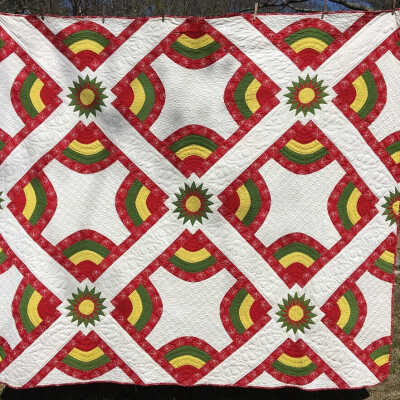
Quilt made by Kitzmiller or DeVault family, "Rocky Road" variation with center star/flower in green/yellow/red with ivy, large square of print red and white/solid red/yellow and green tiny prints in arcs at each corner, part of binding only basted in place. white ground, center machine and hand quilted, 88" x 77", 1890-1910. Regional characteristic: Quilts lack a border, no matter how formal it is meant to be-- the pattern goes to edge and ends there. One idea is that it was meant to be tucked under the mattress as a blanket rather than spread over the top as a cover with sides hanging down to view.
Quilt
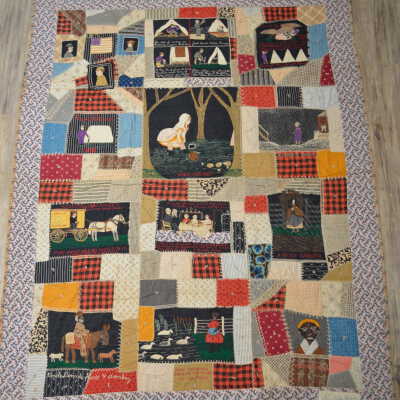
Crazy quilt made by Lillie Harvey, 3 strips--17.5" wide, hand sewn, embroidery/stuffed work/ beading/painting, borders tied with string at about 6" intervals so that knots are in center of crazy-pieced blocks but not in pictorial blocks, red, black, gray and navy cotton fabrics, includes briar stitching among other stitching. Yarn is thick so stitching is not as tight (and close) as crazy quilt embroidery of the 1880s. Top half of quilt depicts soldiers in vignettes--tents, in a boat, marching in snow. Also stitched are "1861 1898 1914" and "Camp Poland" as well as several sentences under each that mention Knoxville businesses of the time (Portlocks Bargain Book Store, Ramage's Book Store, Palace Shoe Store, Beaman Bros. & Co.). Upper right corner shows an embroidered eagle and banner with "Hatched in 1861 Died in 1881 Old Abe* is dead and Gone ...." Largest block in center is of a young girl, with the plea "Wait for Me!"** Other blocks depict a family seated to a meal, a horse-drawn dairy truck, a woman with Bible under arm walking in the rain***, and three black figures--Uncle Dennis Hall, Topsy feeding ducks, and Aunt Dinah. "Conversation prints" are included in the fabric choices. The backing is cotton; woven plaid in navy, orange, and beige. Binding is from back to front, bound by machine along the edge. Center of the quilt has no batting. Three cloth hanging loops were removed. Tag attached at lower right corner reads "Miss Lillie Harvey Brandau Hill Clinton Pike/City." 79 1/2"l x 64 1/2"w, 1898-c. 1915. * Old Abe was eagle mascot of Wisconsin regiment. ** "Wait for Me!" based on painting by Sophie Anderson of the same name, 1880s. *** "A Rainy Sabbath" based on painting by Irish-Scots painter Erskine Nicol (1825-1904) of the same name, 1880s, print of engraving by Illman Brothers may have run in Peterson's magazine.
Quilt
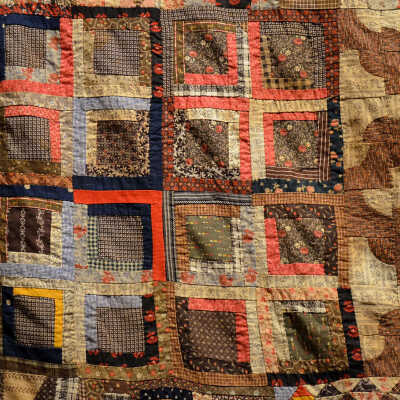
Sampler quilt top made by Iora Almina Philo Pool*, pieced cotton/assorted fabrics and colors with predominance of brown, block pattern, dozens of traditional and original blocks in small and miniature scale, some applique, irregular set, signed IOP, 83" x 74", c. 1870. Backing added at later time. Note: Fabric case made by Linda to carry/store quilt in box but not accessioned. * spelling of Pool/Poole varies within public records ** some being smaller versions of patterns published in farm magazines and quilt catalogs in the 1890s
Quilt
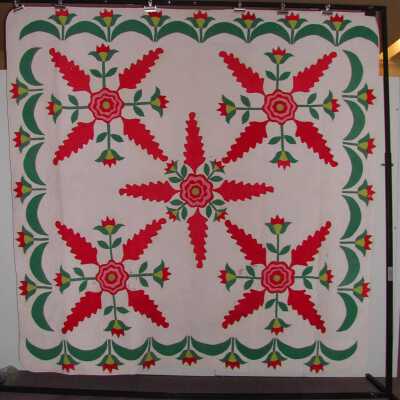
Quilt, "Rose of Sharon" pattern, unknown maker, handsewn with newer machine-applied binding, five-ring plume center/tulip border, applique well done, machine binding may be newer, five 32" blocks, appliqued by the block, 9" sashing used as part of block, 6" borders, turkey red, yellow, green and white cotton fabrics, quilted by the piece, quilted with cross hatching and dense parallel lines (1/4" to 1/2" apart) in the background, quilted border swags with colored thread, seven stitches/inch with cotton thread, orienting with initials on the back of the bottom right corner, the top right unit has overhand blind stitching along the edge, all other units are top stitching, center medallion added by rectangular insets and center square, seamed top, green quilting thread used in the green applique, red quilting thread over the red, both show the design on the back (a regional characteristic), loop of material--as for hanging on a peg--is centered on one side of back, initials "HKC" [Hugh Kennedy Campbell] in ink in one corner, round corners, 92"h x 89 1/2"w, c. 1860. Per Merikay Waldvogel-- "Really beautiful. Beautiful flow to plume design and five-ring center. Construction is spectacular. Five plumes (instead of four) is very unusual." Atypical for Tennessee: 1) The border. Tennessee applique quilts of this era didn't always have an applique border like this one. 2) The size. This one is large for an applique quilt. Typical for Tennessee: Dark quilting thread used over dark fabric (so that it shows the pattern on the back).
Quilt
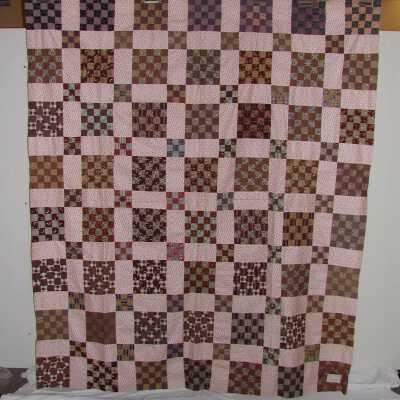
Quilt top. "25 Patch" or "Checkerboard" pattern, made by Martha Jane Armstrong Kennedy, 56 7" patch blocks, 3.5" sashing, 3.5" 9 Patch cornerstones, pieced by the block, handsewn, manganese brown, red and teal cotton fabrics, the set is white-with-red fabric, cotton thread, tacked-on note--in ink, script--in lower right corner reads "M.J. Kennedy to H.K. Campbell 1890" [Martha Jane Kennedy, Hugh Kennedy Campbell], unquilted, most fabrics from the 1860s, c. 1890. Comments by Knoxville quilt historian Merikay Waldvolgel, 1/23/02: "Interesting pattern that combines the Nine Patch with the Checkerboard (or 25 Patch) and forms a strong diagonal effect. Note interesting fabrics in nine patches (spider webs) that are not in larger patches. Date confirms the fabrics [1880s previously used as fabric date]."
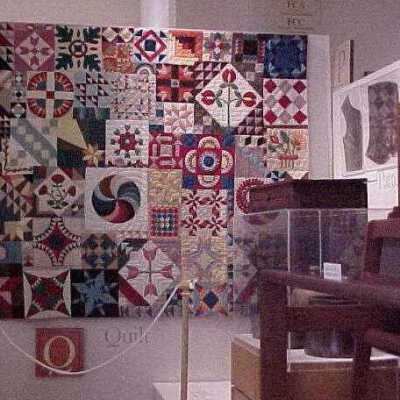
Quilt
The Tennessee Heritage Sampler quilt was made by the Thursday Bee using fabrics dyed by Jim Liles, who followed natural dye techniques. The blocks are from patterns found in Tennessee quilts made prior to 1930. NOTE: 1988 calendar stored in same box; David Luttrell photo of quilt used for March. This is non-accessioned oversize documentation material from Thursday Bee.
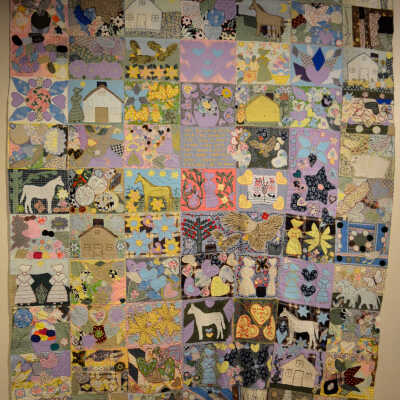
Quilt
Helen Rose-Fleenor made this bed cover, 77 hand pieced and appliquéd blocks with elaborate stitching, mostly buttonhole stitches, includes use of old quilt pieces, embroidered text, crocheted doily and other reused fabric, central panel "We belive [sic] in Jesus for the word of the Lord is right, O Lord I have said that I would keep thy word forever, Jesus loves all his children belive [sic] in him", one block with three hearts "Helln [sic] loves Bill today, Thursday, June 12, 1986, Married March 27, 1978 to 1986", sunbonnet girls, hearts, horses, eagles, structures, elephants, birds, clowns, apple tree with tire planter, flowers, some motifs overlap borders of blocks, mixed fabrics, without backing, 85" x 70", unused, 1986. 4" casing for hanging sewn to top back.
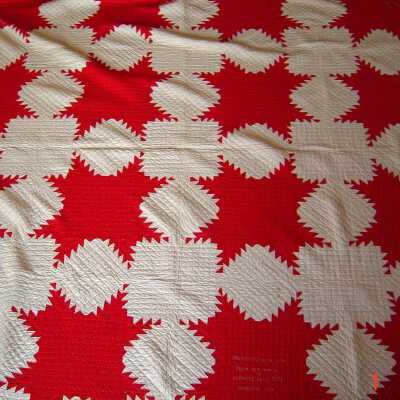
Quilt
Red-and-white feathered star presentation quilt, cotton, embroidered in white with "PRESENTED WITH LOVE FROM HER FAMILY TO GERTRUDE AULT POPE/ MARCH 26, 1928," "VESTA DARWIN AULT/ PIKEVILLE TENNESSEE/ FEB 26 1928/ AGE 79," "ANNIE DARWIN WATERHOUSE/ CHATTANOOGA TENN/ FEB 9 1928/ AGE 77," "MRS. LOLA AULT HIXON/ GALLION, ALA/ FEB 16, 1928," EMMA AULT STONE/ BOISE, IDAHO/ 1928," HELEN DARWIN HIXSON/ GALLION, ALA/ FEB 18, 1928," ARTIE STONE AULT/ MARCH 13, 1928" and "ETHEL AULT WHITE/ SORENTO, FLORIDA/ 1928," quilting with white thread in small squares 3/4" and triangle edging stars 3/4"-3", nine 10" white squares/20 7" white squares, red binding, unused, 83 1/4" x 82 1/2".
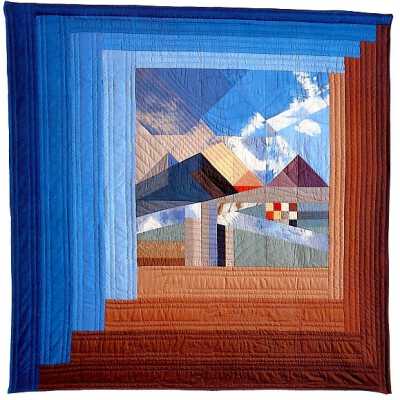
Quilt
Quilt entitled "The Constitution--Freedom's Shelter" made by members of the Thursday Bee, quilted on the front in cursive is "Constitution of/ the United States/ September 1787," uses a contemporary approach to traditional patterns--center is a Nine Patch in an abstract design representing the Appalachian region with its mountains and valleys/rivers and bottomlands/urban-suburban-rural areas/industrial growth and decline, center block is framed with blue and brown "logs" and is in the position of the "hearth and home" block in the Log Cabin pattern, backing made of seven panels of cotton feed sacks (florals, figures, abstracts), fabric dyed with natural dyes of the 1787 period (by Jim Liles), quilted in blue, brown and white thread, typed cloth tag on lower left back reads: "THE CONSTITUTION--FREEDOM'S SHELTER/ Original Design: Linda Claussen/ Centerpiece Quilting: Eva Earle Kent/ Natural Dyeing Techniques circa 1787: Jim Liles/ Backing: Various Patterned Cotton Feed Sacks/ Contributors: Thursday Bee--Smoky Mountain Quilters/ of Tennessee; Sandy Cartwright, Becky Harriss,/ Ginger Neusel, Lessie Werner, Joyce Tennery,/ Joan Rozek, Betty Thacker and Mary Farmer./ Completed: May 1987," 70"l x 70"w.

 →
Donate to the Collections
Historical objects are powerful connectors to the past. As educational tools from which we can learn about individuals and eras, these artifacts are a valuable historical resources.
 →
Artifact Acquisition Fund
Artifacts transcend time to communicate the stories of the past. These “messengers from the past” place us in the presence of history. Help fund our next acquisition.
 →
Artifact Conservation Fund
In some cases, objects are in need of conservation work. Conservation work can be a very expensive cost and in many cases one that the museum cannot afford. Fund our next conservation project.